
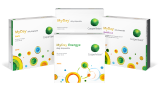

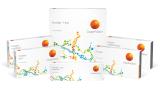
INDICATIONS:
MiSight (omafilcon A) Soft Contact Lenses for Myopia Control are indicated for the correction of ametropia (myopia and hyperopia) in aphakic and non-aphakic persons with non-diseased eyes in powers from -20.00D to +2.00 diopters. The lenses may be worn by persons who exhibit astigmatism of -2.00 diopters or less that does not interfere with visual acuity.
MiSight (omafilcon A) Soft Contact Lenses for Myopia Control may reduce the rate of myopia progression in children (6-18) and correct ametropia. Reduction of myopia progression was observed in children with wearing time of 12 hours (8-16 hours) per day, 6.4 days (5-7) per week in a clinical study. Permanent myopia control after lens treatment is discontinued is not supported by clinical studies.
MiSight (omafilcon A) Soft Contact Lenses for Myopia Control may provide improved comfort for contact lens wearers who experience mild discomfort or symptoms related to dryness during lens wear associated with Evaporative Tear Deficiency or from Aqueous Tear Deficiency (non-Sjogren’s only).
MiSight (omafilcon A) Soft Contact Lenses for Myopia Control are indicated for single use daily disposable wear. When prescribed for daily disposable wear, the lens is to be discarded after each removal.
IMPORTANT SAFETY INFORMATION:
PROBLEMS WITH CONTACT LENSES AND LENS CARE PRODUCTS COULD RESULT IN SERIOUS INJURY TO THE EYE. Patients should be cautioned that proper use and care of the contact lenses and lens care products, including lens cases, are essential for the safe use of these products. It is essential that patients follow their eye care practitioner’s directions and all labeling instructions for proper use of lenses and lens care products. Patients should fill their lens case with fresh solution every time they store their lenses, and never re-use solution. Additionally, they should clean and rinse their lens case between uses as recommended by their eye care practitioner. Eye problems, including corneal ulcers, can develop rapidly and lead to loss of vision.
Who Should Not Use MiSight 1 Day Soft Contact Lenses?
Do not use the MiSight lens when any of the following conditions exist:
Previously diagnosed primary Sjogren’s Syndrome Tear Deficiency and Autoimmune Connective Tissue Disease which may involve secondary Sjogren’s syndrome. Such conditions include rheumatoid arthritis, polyarthritis, Wegener’s granulomatosis, systemic lupus erythematosus, systemic sclerosis, primary biliary cirrhosis, and mixed connective tissue disease.
Acute and subacute inflammation or infection of the anterior chamber of the eye.
Any eye disease, injury, or abnormality that affects the cornea, conjunctiva, or eyelids.
Severe insufficiency of lacrimal secretion (dry eyes).
Corneal hypoesthesia (reduced corneal sensitivity), if not aphakic.
Any systemic disease that may affect the eye or be exaggerated by wearing contact lenses.
Allergic reactions of ocular surfaces or adnexa that may be induced or exaggerated by wearing contact lenses or use of contact lens solutions.
Any active corneal infection (bacterial, fungal, or viral).
If eyes become red or irritated.
The patient is unable to follow lens care regimen or unable to obtain assistance to do so.
WARNINGS AND PRECAUTIONS:
Adult supervision of children to ensure proper user compliance for lens insertion, wear and removal is recommended.
Daily wear single use only. Patient should always dispose when lenses are removed. No overnight wear.
Do not use saliva or anything other than the recommended solutions for lubricating or wetting lenses.
If the lens sticks (stops moving) on the eye, follow the recommended directions on Care for a Sticking Lens. The lens should move freely on the eye for the continued health of the eye. If non-movement of the lens continues, the patient should be instructed to immediately consult his or her eye care practitioner.
Always wash and rinse hands before handling lenses. Do not get cosmetics, lotions, soaps, creams, deodorant, or sprays in the eyes or on the lenses. It is best to put on lenses before putting on makeup. Water-based cosmetics are less likely to damage lenses than oil-based products.
Do not touch the contact lenses with the finger or hands if the hands are not free of foreign materials, as lens damage may occur.
Carefully follow the handling, insertion, removal, cleaning, and wearing instructions in the Patient Instructions for MiSight contact lenses and those prescribed by the eye care practitioner.
Never wear lenses beyond the period recommended by the eye care practitioner.
If aerosol products such as hairspray are used while wearing lenses, exercise caution and keep eyes closed until the spray has settled.
Always handle lenses gently and avoid dropping them.
Avoid all harmful or irritating vapors and fumes while wearing lenses.
Ask the eye care practitioner about wearing the lenses during sporting activities.
Lenses prescribed on a daily disposable wearing schedule should always be discarded when removed at the end of the wearing day.
Inform the doctor (health care practitioner) about being a contact lens wearer.
Never use tweezers or other tools to remove lenses from the lens container unless specifically indicated for that use. Pour the lens into your hand.
Do not touch the lens with fingernails.
Always contact the eye care practitioner before using any medicine in the eyes.
Always inform the employer of being a contact lens wearer. Some jobs may require use of eye protection equipment or may require that the patient not wear contact lenses.
As with any contact lens, follow-up visits are necessary to assure the continuing health of the patient’s eyes. The patient should be instructed as to a recommended follow-up schedule.
Adverse Reactions
The patient should be informed that the following problems may occur:
Eyes stinging, burning, or itching (irritation), or other eye pain.
Comfort is less than when the lens was first placed on the eye.
Feeling that something is in the eye such as a foreign body or a scratched area.
Excessive watering (tearing) of the eyes.
Unusual eye secretions.
Redness of the eyes.
Reduced sharpness of vision (poor visual acuity).
Blurred vision, rainbows, or halos around objects.
Sensitivity to light (photophobia).
Dry eyes.
If the patient notices any of the above, he or she should be instructed to:
Immediately remove the lenses.
If the discomfort or the problem stops, then look closely at the lens. If the lens is in some way damaged, do not put the lens back on the eye. If the problem continues, do not put the lens back on your eye; immediately remove the lenses and consult the eye care practitioner.
When any of the above problems occur, a serious condition such as infection, corneal ulcer, neovascularization, or iritis may be present. The patient should be instructed to keep the lens off the eye and seek immediate professional identification of the problem and prompt treatment to avoid serious eye damage.
By prescription only. Results may vary. Please reference the Patient Information Booklet for a complete listing of Indications and Important Safety Information.
SA17103_rev1
APP160075